
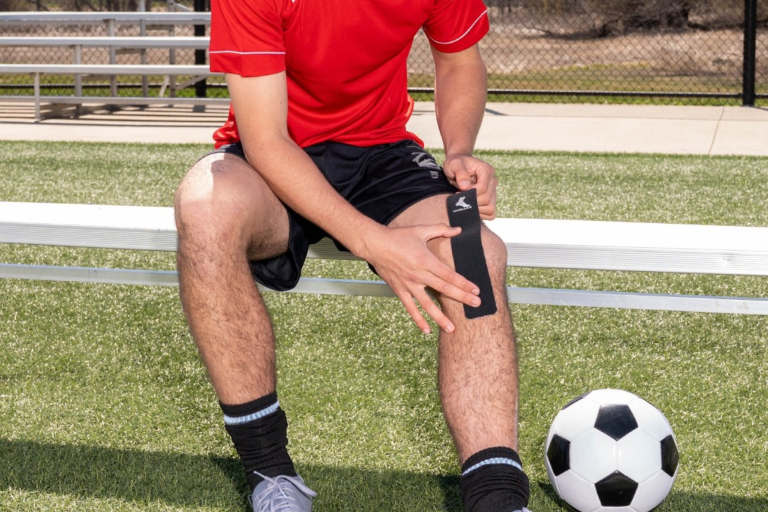

You’ve probably seen it on pro athletes during games, on runners at the starting line, or on a teammate during practice. That colorful tape stretched across a knee or shoulder is kinesiology tape, and it’s become a go-to tool in sports medicine for a reason.
Unlike rigid athletic tape, kinesiology tape is flexible. It’s designed to help provide support to muscles and joints without limiting range of motion. You can wear it during a workout, through a full day at work, and even while you sleep. Getting the application right can be a bit tricky, so let’s break down the basics and how to apply it properly.
What Is Kinesiology Tape Used For?
Kinesiology tape is a thin, stretchy, adhesive tape applied directly to the skin over muscles and joints. It’s different from traditional athletic tape, which is commonly used to provide firm support and stability during physical activity.
Kinesiology tape is commonly used to:
- Help provide support to muscles and joints during activity
- Help reduce pain while supporting your muscles, tendons, and ligaments
- Allow full range of motion while wearing
It’s popular with athletes, athletic trainers, and active adults who want support without feeling locked up in a brace.
How Do You Use Kinesiology Tape: General Rules
Before applying kinesiology tape to any body part, a few principles apply across the board. Getting this right is the difference between tape that holds for days and tape that peels off in an hour.
- Clean, dry skin: No lotions, oils, or sweat. Adhesive sticks best to bare, dry skin.
- Round the corners: If you’re cutting your own strips, round the edges with scissors. Sharp corners catch on clothing and peel up faster.
- Stretch the tape, not the skin: Apply the anchor ends (the first and last inch of each strip) with zero stretch. The stretch goes in the middle only.
- Rub to activate: After placing the tape, rub your hand over it for a few seconds. The friction generates heat that activates the adhesive.
- Apply 30 to 60 minutes before activity: This gives the adhesive time to bond with the skin before you start moving.
Kinesiology Tape for the Knee
The knee is one of the most commonly taped joints. Kinesiology tape knee applications typically target the area around the kneecap or along the sides of the joint. It’s often used for general soreness around the patella, quad tightness, or for extra support during runs, squats, or court sports.
How to apply
- Sit with your knee bent at about 90 degrees.
- Cut two strips long enough to run from a few inches above the kneecap to a few inches below.
- Anchor the first strip below the knee with no stretch. Apply upward along the outer edge of the kneecap with moderate stretch (about 50%). Lay the top anchor down with no stretch.
- Repeat on the inner edge, creating a frame around the kneecap.
- Rub firmly to activate the adhesive.
Kinesiology Tape for the Ankle
Kinesiology tape for ankle support is a lighter alternative to a full rigid tape job. It works well for supporting muscles during day-to-day activity or during lower-intensity sessions, and is often used after a mild sprain has settled or during return-to-activity phases.
How to apply
- Sit with your foot flexed at 90 degrees.
- Anchor one strip on the outside of the lower leg, a few inches above the ankle bone.
- Pull the strip down under the heel with moderate stretch and up the inside of the leg. Lay the anchor down with no stretch.
- For extra support, apply a second strip in a figure-eight pattern around the ankle.
- Rub to activate.
If you prefer a pre-cut option that takes the guesswork out of sizing, Mueller makes an EasyFit® Kinesiology Pre-Cut tape for calf & ankle with ready-to-apply shapes and instructions included.
Kinesiology Tape for the Shoulder
Shoulder applications are trickier because the joint moves in so many directions. Kinesiology tape shoulder applications typically follow the shape of the deltoid muscle and can be helpful for general discomfort around the deltoid or rotator cuff area, or for support during overhead activities like throwing or lifting.
How to apply
- Sit or stand with your arm relaxed at your side.
- Anchor one strip at the front of the shoulder, near the collarbone.
- With moderate stretch, lay the strip along the front edge of the deltoid and down the outside of the upper arm. End with no stretch.
- Repeat with a second strip along the back edge of the deltoid.
- Rub both strips to activate.
Choosing the Right Kinesiology Tape
Not all kinesiology tapes provide equal support. Pay attention to adhesive quality, stretch, and how well it holds up during movement and sweat.
A solid option like the TYPHOON® Kinesiology Tape uses a wave pattern adhesive that moves with your skin and muscles. It helps reduce pain while supporting your muscles, tendons, and ligaments, and it’s water-resistant. You can get it in continuous rolls for custom cuts or in pre-cut strips for quick application.
Your Body, Your Support
Kinesiology tape is a simple, low-profile way to help support your muscles and joints while staying active. Apply it correctly, choose the right product, and you are set.
Mueller Sports Medicine has been helping athletes Stay In The Game for over 60 years. Whether it’s your knee after a long run, your shoulder before practice, or your ankle on a weekend hike, the right tape can help you keep moving with confidence.
Shop Mueller® kinesiology tape for flexible support that moves with you.
FAQs
How long does kinesiology tape last once applied?
Most kinesiology tape is designed to stay on for 3 to 5 days when applied correctly. Proper skin prep (clean, dry, no lotion) and rubbing the tape to activate the adhesive after application are the biggest factors in how long it holds.
Can you shower with kinesiology tape on?
Yes. Quality kinesiology tape is water-resistant, so showering is fine. Pat the tape dry afterward rather than rubbing it. Avoid long soaks in a hot tub or pool, as extended water exposure can loosen the adhesive.
Is kinesiology tape the same as athletic tape?
No. Athletic tape is rigid and restricts motion, providing firm support and compression. It’s typically removed after each activity. Kinesiology tape is flexible, moves with the body, and is designed to help provide support without limiting range of motion. It can be worn for multiple days.
Can you wear kinesiology tape all day?
Yes. Kinesiology tape works throughout the day, including during workouts, daily activities, and other physical activity.
Can you sleep with kinesiology tape on?
Yes. Kinesiology tape can be worn overnight when applied correctly, provided it feels comfortable.